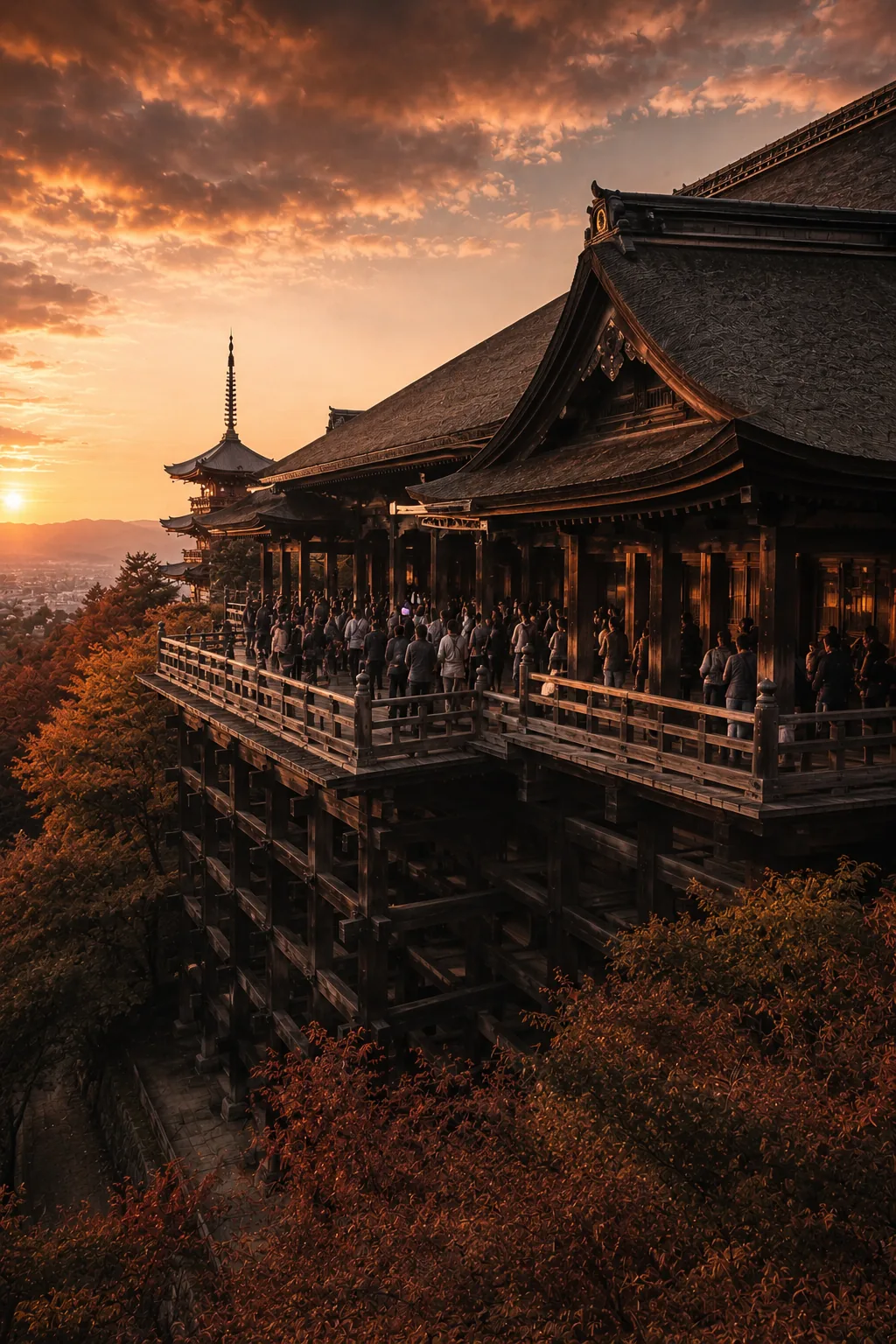
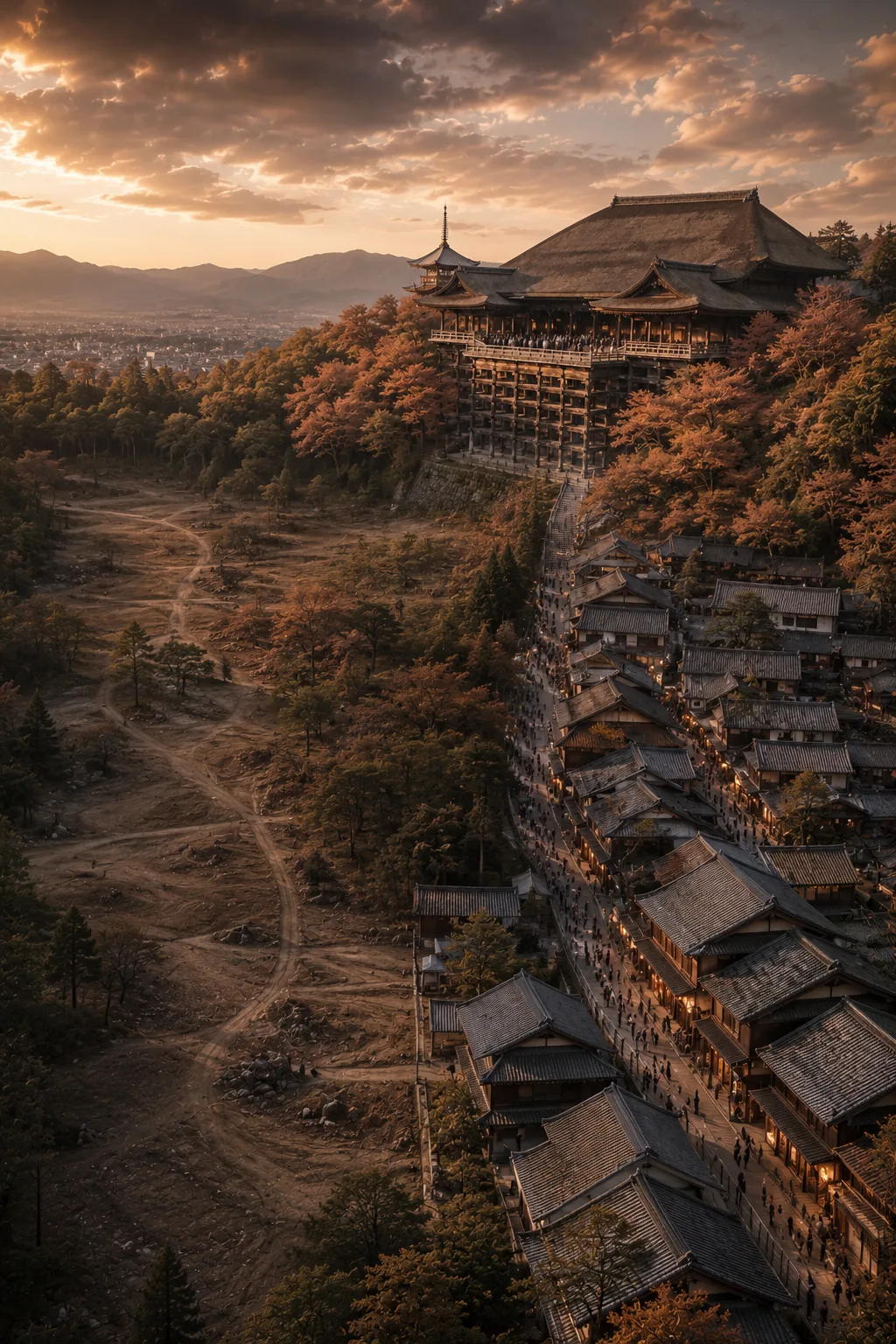
The truly remarkable thing about Kiyomizu-dera, I think, is neither the height of its famous stage nor the nail-free joinery. Founded in 778, with the present halls rebuilt in 1633, it has never once stopped — it is still earning today. For more than a thousand years it has remained a working economic engine. That is what draws me to it.
So with THE STUMP, too, my benchmark is neither design nor height. Can it keep generating value for a thousand years after it is built? That is the only question. Kiyomizu-dera is one of the very few examples that has actually pulled this off. So — how much does Kiyomizu-dera actually earn? Let me start with the most obvious place: the admission fee.
Few people, I suspect, have ever seriously added up the admission revenue of Kiyomizu-dera. Do the math, and it is faintly anticlimactic.
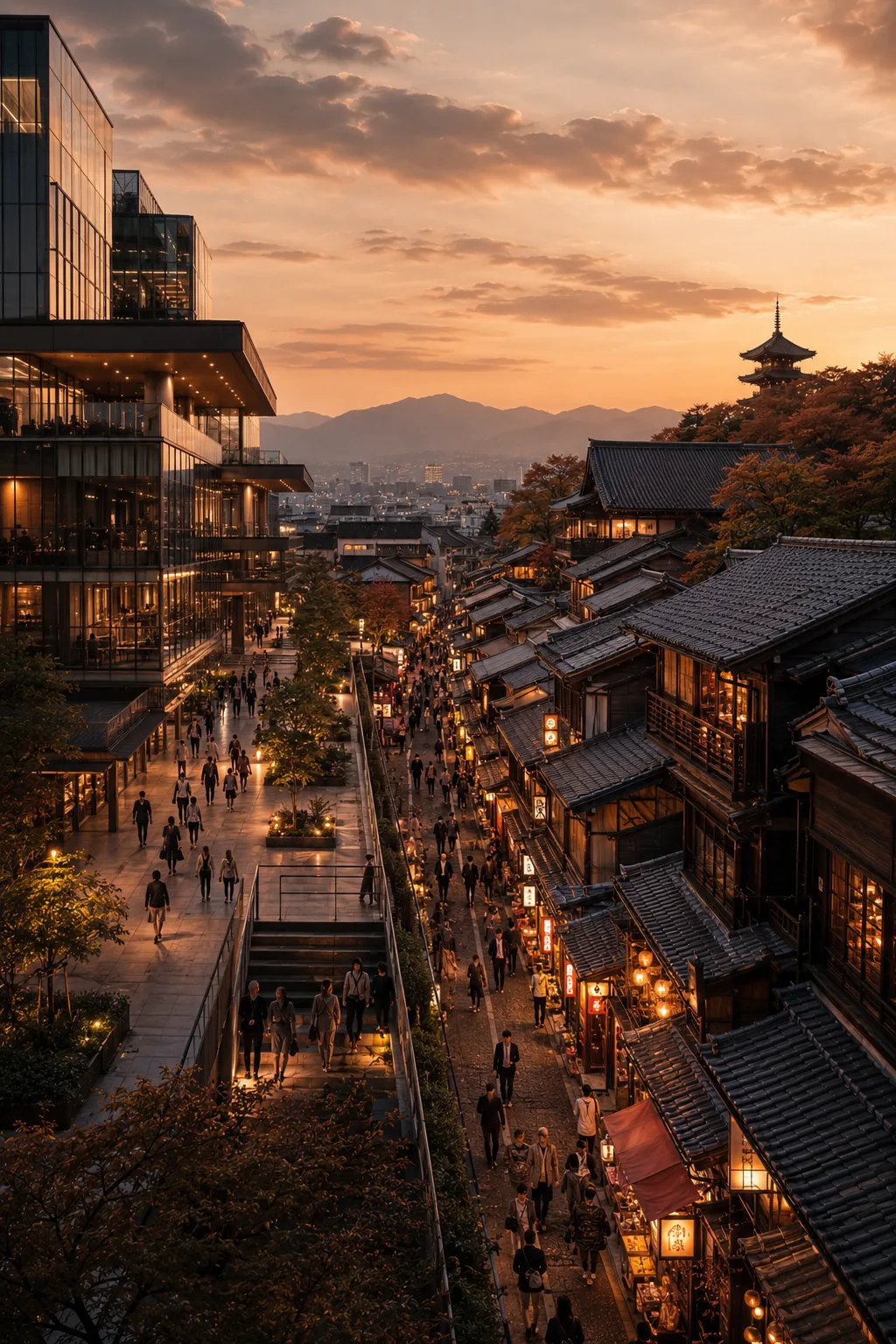
Annual visitors come to roughly five million. At ¥500 per adult, that is only ¥2.5 billion. Add up the charms, the goshuin stamps, the offerings and the special viewings, and the temple’s yearly income is at most ¥3– 4.5 billion (no financial statements are published, so this is an estimate). Hand it to a real-estate appraiser and the number gets colder still. It is a mass of mountain, slope and heritage restrictions, so no sane price-per-tsubo applies. On paper, Kiyomizu-dera ends up as nothing more than a "decent income property."
— But that number says nothing true about Kiyomizu-dera at all. This column begins right there.
Kiyomizu-dera’s real business is not the admission fee — that is more of a side gig. Its true business is keeping a constant flow of people pouring through the whole Higashiyama district.
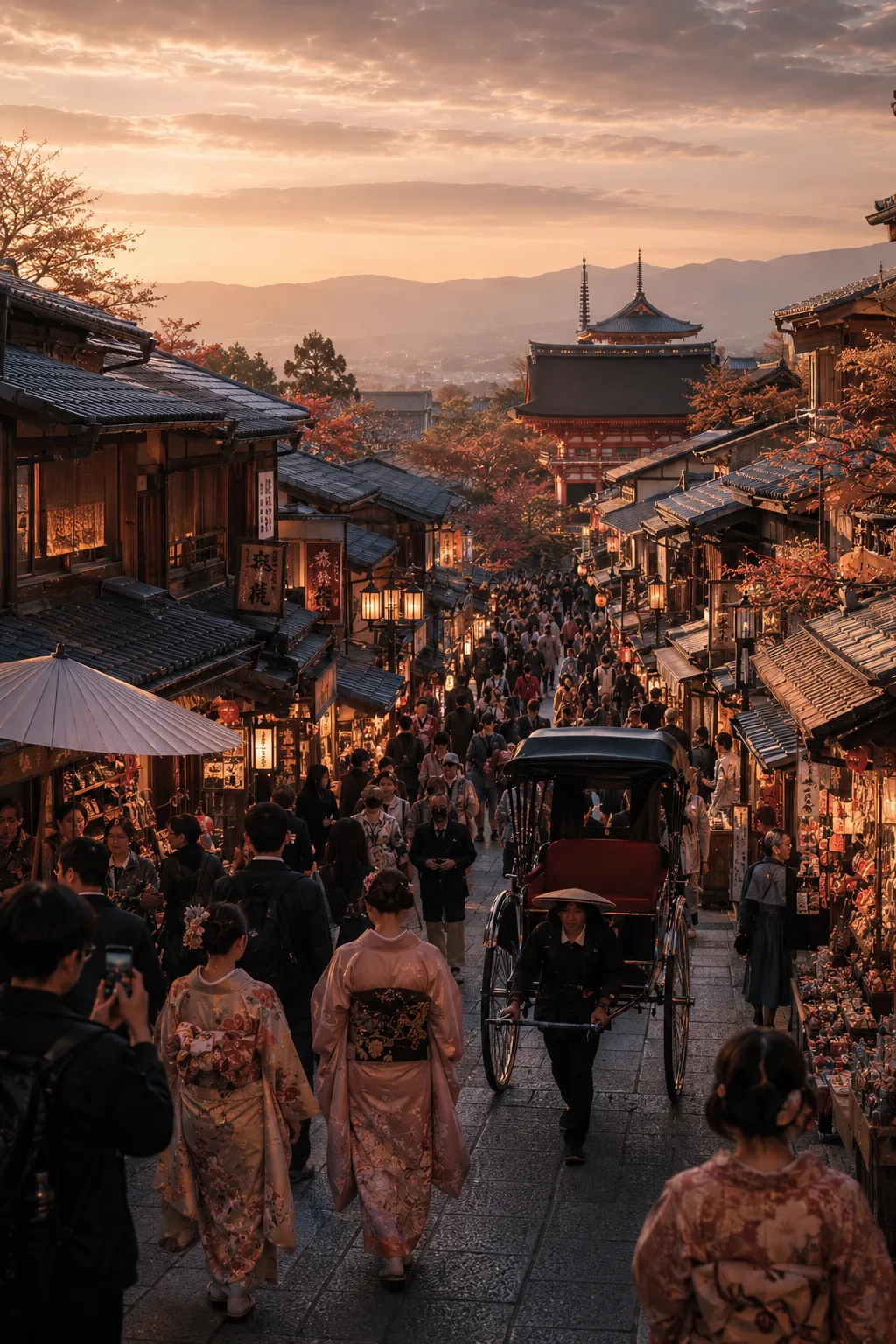
Kiyomizuzaka, Ninenzaka, Sannenzaka, Gion — the restaurants, souvenir shops, inns, taxis and kimono rentals of that quarter, the wages of the people who work there, the rents the tenants pay — almost all of it hangs on the single fact that "Kiyomizu-dera is there." Put what one visitor spends nearby because of Kiyomizu-dera conservatively at ¥10,000– 20,000. Multiply by five million and you get ¥50– 100 billion a year — twenty to forty times the admission revenue. Kyoto’s total tourism spending in 2024 was about ¥1.9 trillion, or ¥34,000 per head. Against that, ¥10,000– 20,000 traceable to Kiyomizu-dera is hardly an inflated figure. If anything, I think it is conservative.
In other words, Kiyomizu-dera fills not its own purse but the town’s. Good architecture, as a rule, does exactly this. It does not close its accounts within its own lot. It scatters economy beyond its own walls.
So Kiyomizu-dera carries two utterly different price tags. Dumped on the market as a property, perhaps ¥70 billion. Seen as the cultural infrastructure that keeps Kyoto turning, ¥3 trillion. Neither is a lie. They simply look at it from different angles.
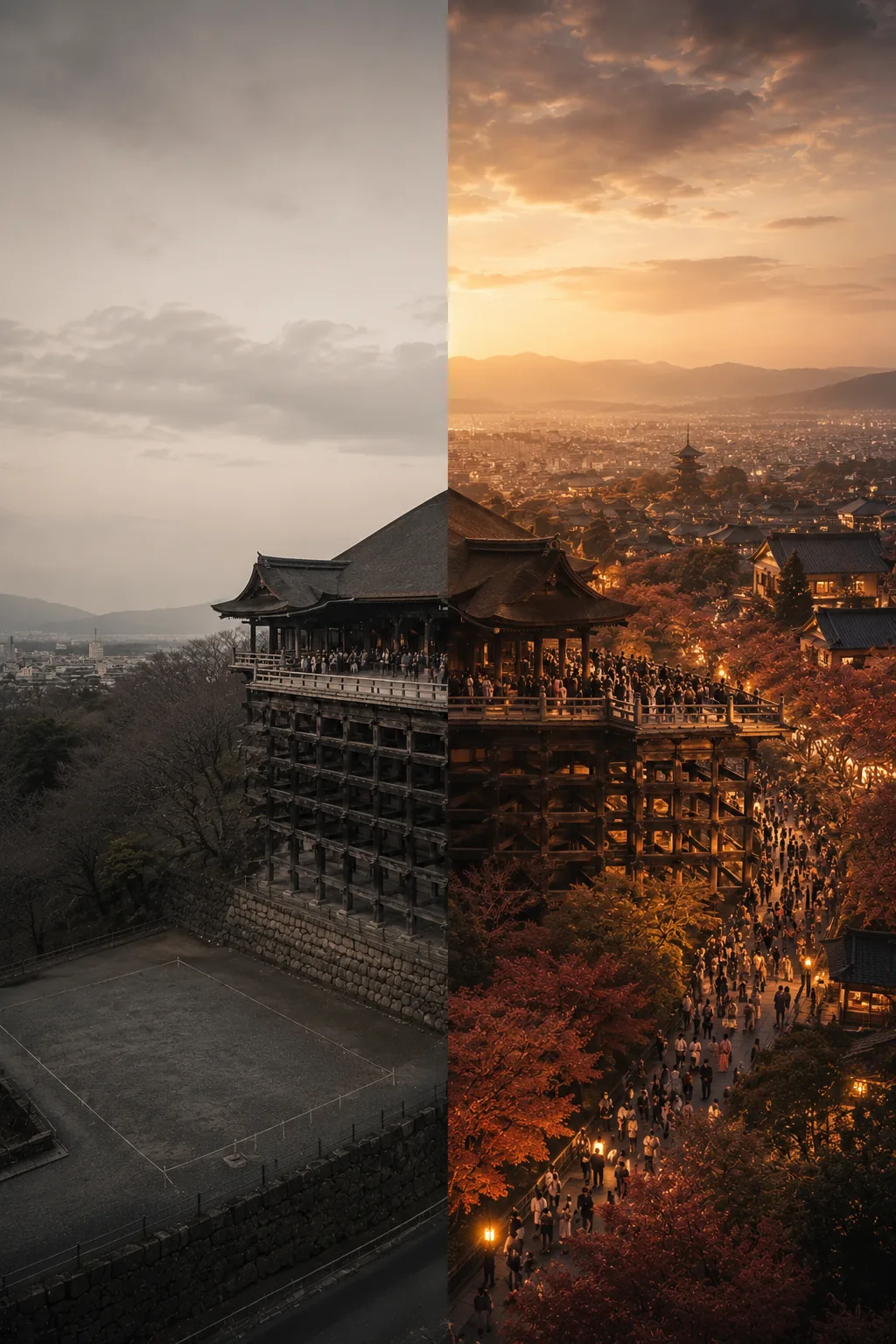
The precincts cover about 130,000 m² — roughly 39,000 tsubo. Spread ¥3 trillion across that and you get ¥76 million per tsubo. A mountain slope in Kyoto, valued at a price-per-tsubo on par with Ginza. It may sound absurd. But this is not a number produced by the land’s own nature. History, faith, story and time have swollen the original land value hundreds of times over. The land itself is merely the trigger.
This is the most important point, so let me be blunt. Kiyomizu-dera is not valuable because it was built on prime Kyoto land. The land around it became prime because Kiyomizu-dera was built — the order is reversed. Astonishingly many people, even in the industry, get this backwards.
Ordinary real estate is priced as "land cost + construction cost + yield." So, however you slice it, the local market rate becomes the ceiling. Kiyomizu-dera is priced as "a reason to go there × drawing power × time × ripple into the town." So it blows straight through the market rate. This is not an outlier. It simply stepped outside the market.
The ultimate form of real-estate producing is not the trick of making good land look expensive. It is generating, after the fact, value the land never originally had. You do not follow the market rate. You draw it — you move to the side that adds a line to the map.
Now, the large-scale redevelopments rising one after another on prime city-centre land — those mixed-use tower clusters stacking office, retail and residence into a single building — are doing the exact opposite of everything I have described. State-of-the-art facilities, top overseas brands, contemporary art, a well-made wellness floor. The opening-day photos are, without exception, dazzling. But line up two or three of them and you notice it at once: the lineup of names is almost identical.
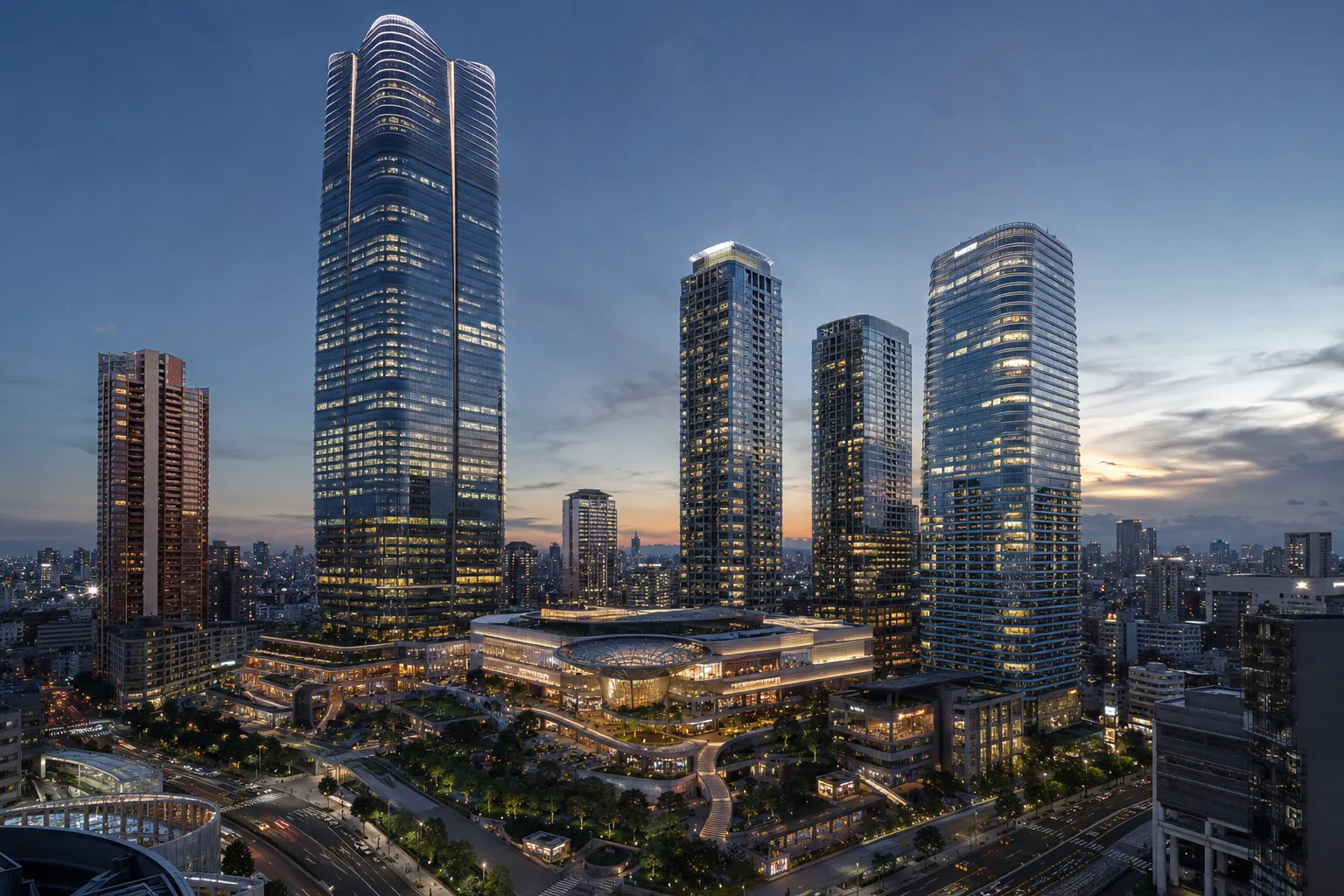
The reason is plain. New-build floor space is expensive to construct. The only tenants who can pay that rent are the luxury labels found in every city on earth, and the national chains. So every redevelopment fills up with the same faces. It is not that developers dislike character — the rent arithmetic itself drives character out. Yet a town where culture grows is, without exception, a cluster of one-of-a-kind independent shops. Chains are highly efficient, but they have no variance. Where there are no surprises, a reason to make the trip rarely takes root.
Here, return to the LTV lens. The development most dazzling on opening day is not necessarily the one creating the most value a century later. More often, the opposite is true. A lineup found everywhere produces only value found everywhere, so it is eventually dragged back to the market rate and slides downward as its fixtures age. The cluster of independent shops accreted around Kiyomizu-dera over a thousand years, meanwhile, still draws people to Higashiyama today. Lavishness and richness are different. Lavishness peaks on opening day; richness accumulates over time. Which kind of town you are building is something the opening ceremony cannot answer — the LTV a hundred years out grades the paper.
A building generates revenue.
A masterpiece generates a city.
What I am trying to build with THE STUMP is, in short, a modern Kiyomizu-dera. The supertall-residence shell, frankly, I could not care less about.
I cannot think of a single reason why what 778 Kyoto could do, 2020s Tokyo cannot. Architecture need not be a 30-year disposable. Built once, earning for a long time, its meaning renewed as owners change hands, scattering economy and culture around it — to raise such an engine once more, in this age. That is all there is to do.
Kiyomizu-dera has already proved it. The finest real estate is the ownership of "a reason people will go there, forever." Not the timber, not the land. Whether or not you hold that reason.